Polonnaruwa sits 57 km (35 miles) from Sigiriya and 68 km (42 miles) from Dambulla, both within Sri Lanka's Cultural Triangle. A private transfer between any of these towns typically takes around 1 to 1.5 hours, making it easy to see the rock fortress, cave temples, and ancient city in a single well-paced day.
Most travelers spend around 2 to 3 hours seeing Polonnaruwa's key monuments. The archaeological park is spread across several kilometers of flat, open ground, so many visitors explore by bicycle, tuk-tuk, or simply move between clusters of ruins with their vehicle rather than walking the whole site.
Both are UNESCO World Heritage cities, but Polonnaruwa's ruins are more concentrated and quicker to explore, while Anuradhapura is older and spread across a much larger area. Polonnaruwa's proximity to Sigiriya and Dambulla also makes it easier to fit into a single day trip through the Cultural Triangle without rushing.
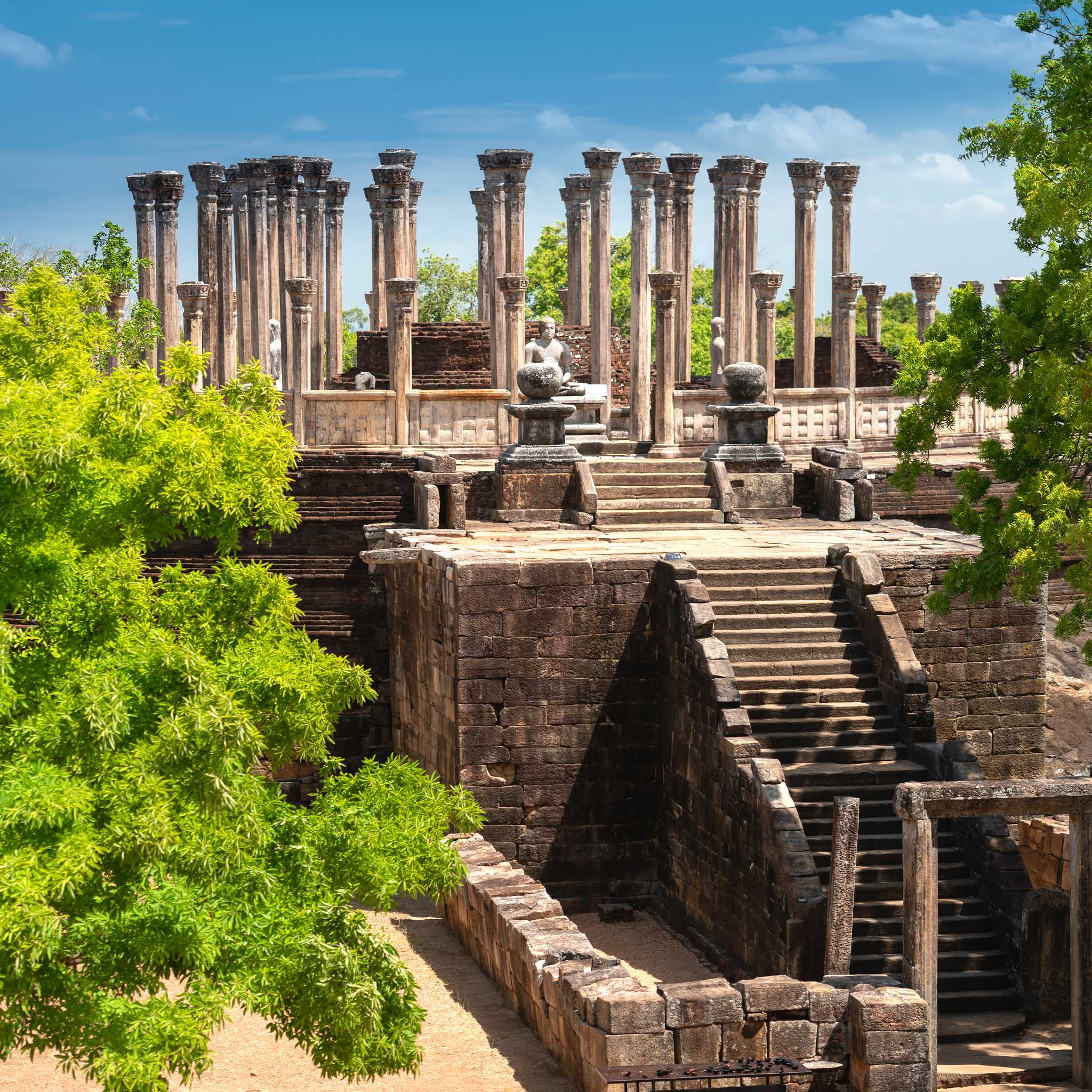
Highlights include the Gal Vihara rock-cut Buddha statues, the Quadrangle with its circular Vatadage shrine and stepped Satmahal Prasada, the ruins of the Royal Palace, and the massive Rankoth Vihara stupa. Many itineraries also stop at Parakrama Samudra, the vast reservoir built by King Parakramabahu I that still irrigates the region today.
Polonnaruwa was Sri Lanka's medieval capital in the 11th to 13th centuries, and its UNESCO World Heritage ruins are among the best preserved in the country. Unlike more sprawling ancient sites, its palaces, temples, and stupas sit close together within a compact core, so you can take in the highlights without a full day of walking. The intricately carved Gal Vihara Buddha statues alone make the stop worthwhile.
Polonnaruwa remains a sacred Buddhist site, so shoulders and knees should be covered, and shoes and hats come off at Buddha images and stupas. The park has little shade and can get hot by midday, so comfortable footwear, water, and sun protection make the visit easier.