Marvão sits in Portugal's eastern Alentejo, close to the Spanish border. From Lisbon the distance is approximately 220 km (137 miles), and the drive typically takes around 2.5 to 3 hours by private transfer. From Évora the distance shrinks to roughly 130 km (81 miles), making it a natural extension of an Alentejo itinerary rather than a standalone commitment. From the Spanish side, Cáceres is approximately 90 km (56 miles) away, making Marvão a natural cross-border stop for travelers moving between Portugal and the Extremadura region of Spain.
Two to three hours inside the walled village is enough to walk the walls, explore the castle, and take in the main sights without feeling rushed. If you add the Roman ruins at Ammaia, allow an extra hour to ninety minutes. For travelers on a longer Alentejo day, Marvão pairs naturally with Portalegre — the regional capital, roughly 20 km (12 miles) to the south — which has a cathedral, a notable tapestry museum, and a more lived-in city atmosphere that contrasts well with Marvão's preserved quietness. A private transfer makes these combinations straightforward, since you set the pace and your driver adapts to how long you actually want at each stop.
The Roman ruins of Ammaia lie a few kilometers below Marvão in the valley, and they add a genuinely different dimension to the visit. Ammaia was a Roman city of some significance, and the site includes excavated forum structures, a museum holding recovered artifacts, and an ongoing sense of archaeological discovery. The Serra de São Mamede Natural Park surrounds the whole area, and the landscape between the park roads and the high granite ridgeline is worth experiencing at a slower pace if your itinerary allows. Together, Marvão's medieval summit and the Roman valley below tell a layered story of the same place across two thousand years.
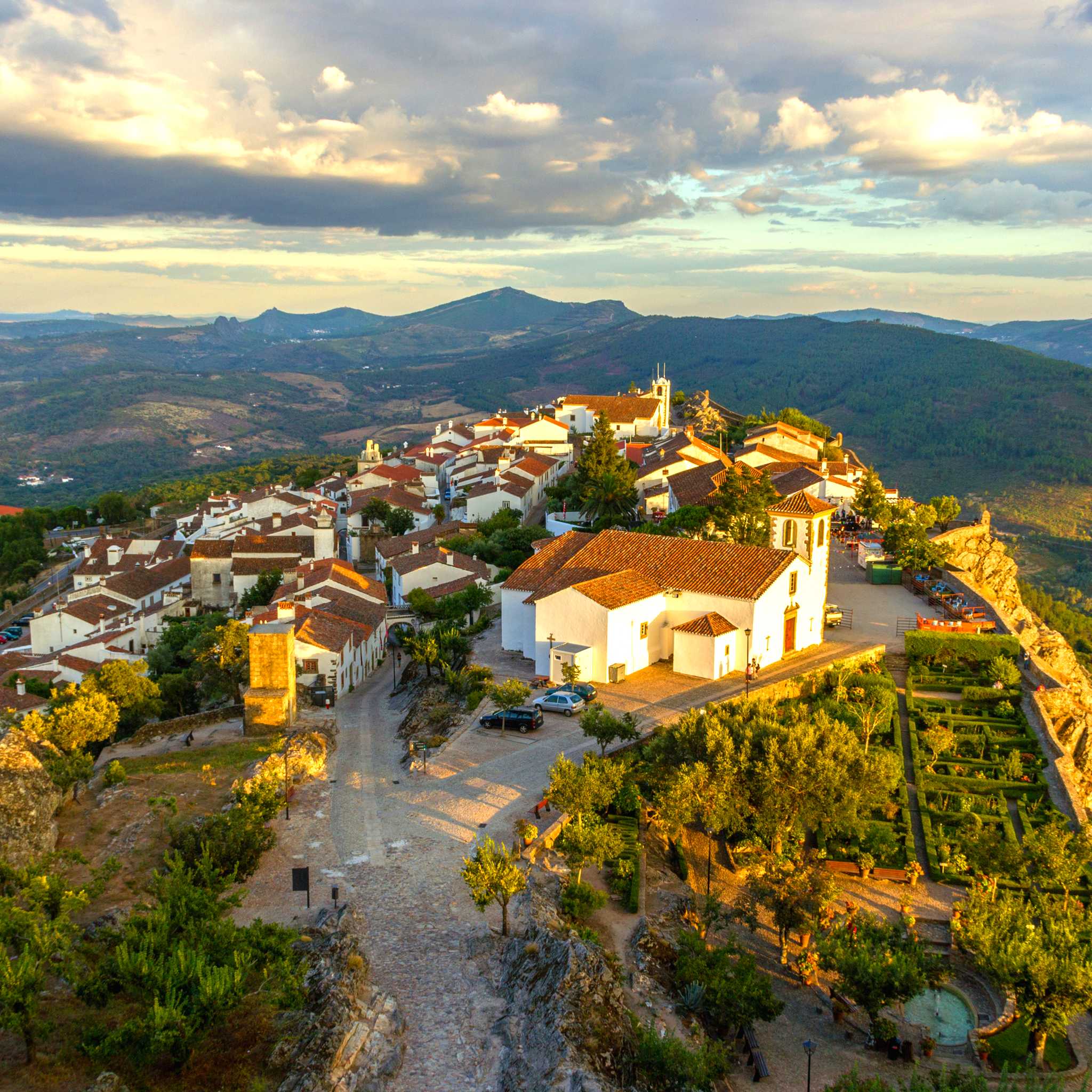
The 13th-century castle is the focal point. Walk the battlements and climb the keep for the views that define the whole experience — on a clear day you can see deep into Spanish territory, with the Alentejo plains falling away in every direction. The village itself is worth wandering without a fixed agenda: the whitewashed houses, the cobbled lanes, and the Igreja de Santa Maria — now housing a small local museum — reward slow exploration. The medieval walls are well enough preserved that you can follow them almost completely around the village perimeter, which gives a real sense of the original scale and intent of the fortification.
Marvão is one of the most dramatically sited villages in Portugal — a tiny medieval settlement perched on a granite spur of the Serra de São Mamede at around 865 meters, with its 13th-century castle and whitewashed houses rising so sharply above the surrounding plains that it reads almost as a mirage from the road below. The views from the castle walls stretch across the Alentejo into Spain on clear days. What sets it apart from Portugal's other walled villages is the combination of genuine completeness — the medieval circuit is largely intact — and an authentic quiet that most similarly photogenic places have long since lost to visitor volume. Coming here feels like finding something rather than visiting somewhere.
The access road up to the village is steep and narrow, as you would expect of a hilltop fortification — arriving by private transfer means that navigation is handled for you and you are dropped as close to the village entrance as the road allows. The village itself is very small and almost entirely pedestrianized, so everything is on foot once you are inside the walls. The terrain is uneven cobblestone throughout, which is worth knowing if mobility is a consideration. Marvão sits at altitude, and the exposed castle walls can be noticeably cooler and windier than the plains below, so an extra layer is useful regardless of the season.