Magdeburg sits about 150 km (93 miles) from Berlin, 120 km (75 miles) from Leipzig, and 145 km (90 miles) from Hannover. A private transfer from Berlin typically takes around 1.5 to 2 hours depending on traffic, with door-to-door pickup that skips station connections, so you arrive ready to explore rather than navigating train schedules.
A half day covers the highlights: the Cathedral of St. Mauritius and St. Catherine, the Green Citadel, and a walk along the Elbe. A full day lets you add the Monastery of Our Lady art museum and linger in the old town squares. Most travelers comfortably see Magdeburg's core sights and still have time for lunch by the river before heading back.
The Green Citadel (Grüne Zitadelle) is one of the last buildings designed by Austrian architect Friedensreich Hundertwasser, known for irregular windows, rooftop greenery, and a rejection of straight lines. It stands out against Magdeburg's older architecture and has become one of the city's most photographed landmarks, a colorful counterpoint to the cathedral's Gothic gravity nearby.
Magdeburg pairs deep imperial history with a burst of modern color. Otto the Great, crowned Holy Roman Emperor in 962, is buried in the city's cathedral, while the Green Citadel brings Friedensreich Hundertwasser's playful architecture right to the Elbe riverside. Add the Monastery of Our Lady's art collection and a walkable old town, and Magdeburg fits centuries of history into a compact, easy-to-explore visit.
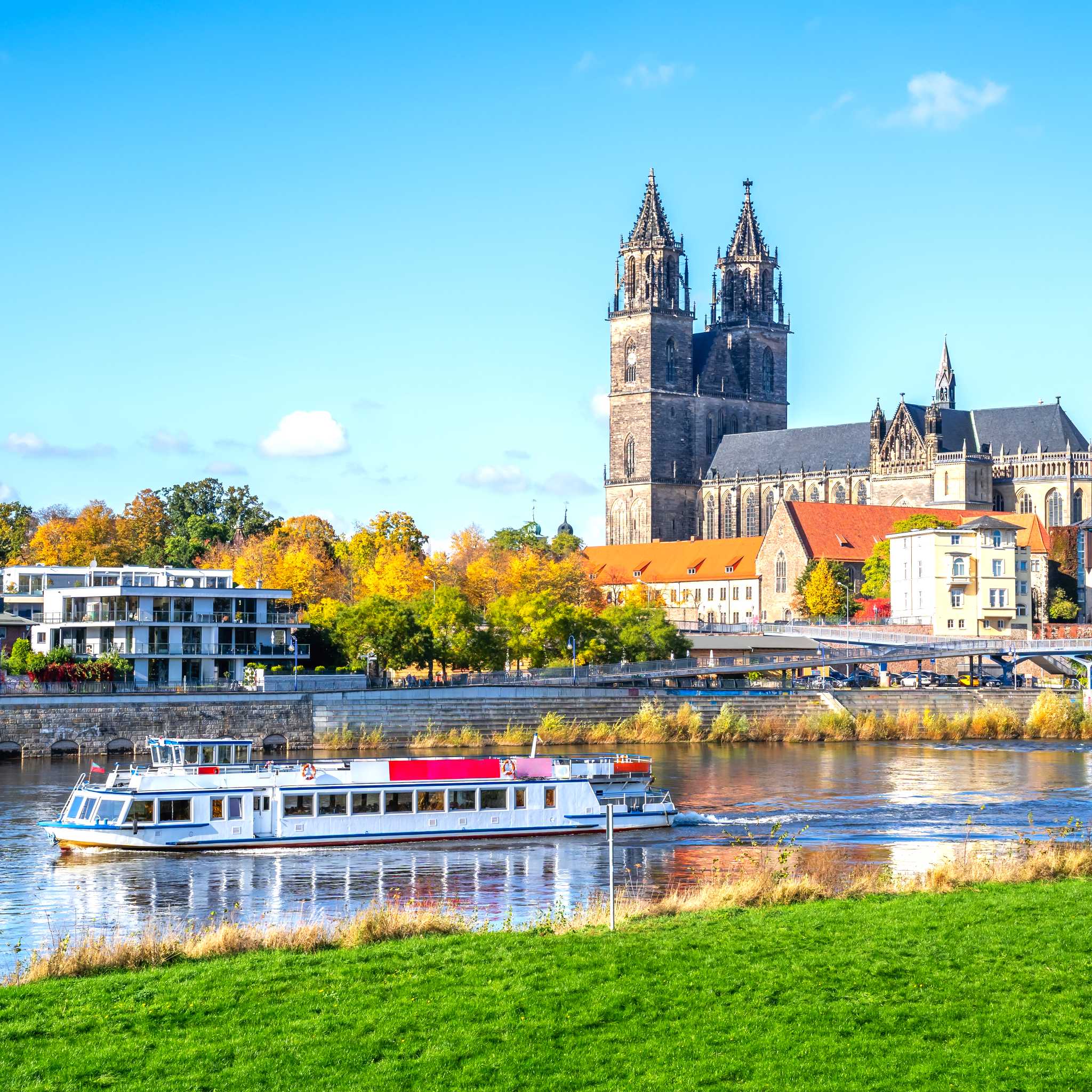
The Cathedral of St. Mauritius and St. Catherine is the resting place of Otto the Great, crowned Holy Roman Emperor in 962, and is often described as one of the first Gothic cathedrals built on German soil. Its soaring interior and imperial tomb make it a highlight of any visit, offering a direct link to the ruler whose legacy still shapes the city today.
Otto von Guericke, Magdeburg's 17th-century mayor and a pioneering scientist, famously demonstrated the power of a vacuum with his Magdeburg hemispheres experiment, in which teams of horses could not pull apart two sealed metal globes. Monuments and exhibits around the city trace his legacy, adding a hands-on science story to Magdeburg's imperial and architectural highlights.