Yes. Elvas is right on the border, just 21 km (13 miles) from Badajoz, about a 20-minute drive. From Seville it's roughly 266 km (165 miles), around 2.5 hours by road. That makes Elvas a natural add-on for travelers exploring Andalusia or Extremadura who want a taste of Portugal without a long detour.
Elvas sits about 211 km (131 miles) east of Lisbon, close to the Spanish border. By private transfer via the A6 motorway, the drive takes around 2 hours each way, leaving a full day to explore the fortress city without an early wake-up call or a return dash for a train.
Half a day is enough to see the highlights at an easy pace: the castle, the cathedral, Santa Clara square, and a stretch of the aqueduct and walls. The old town is compact and walkable, though cobbled streets and hilly lanes mean comfortable shoes are a good idea.
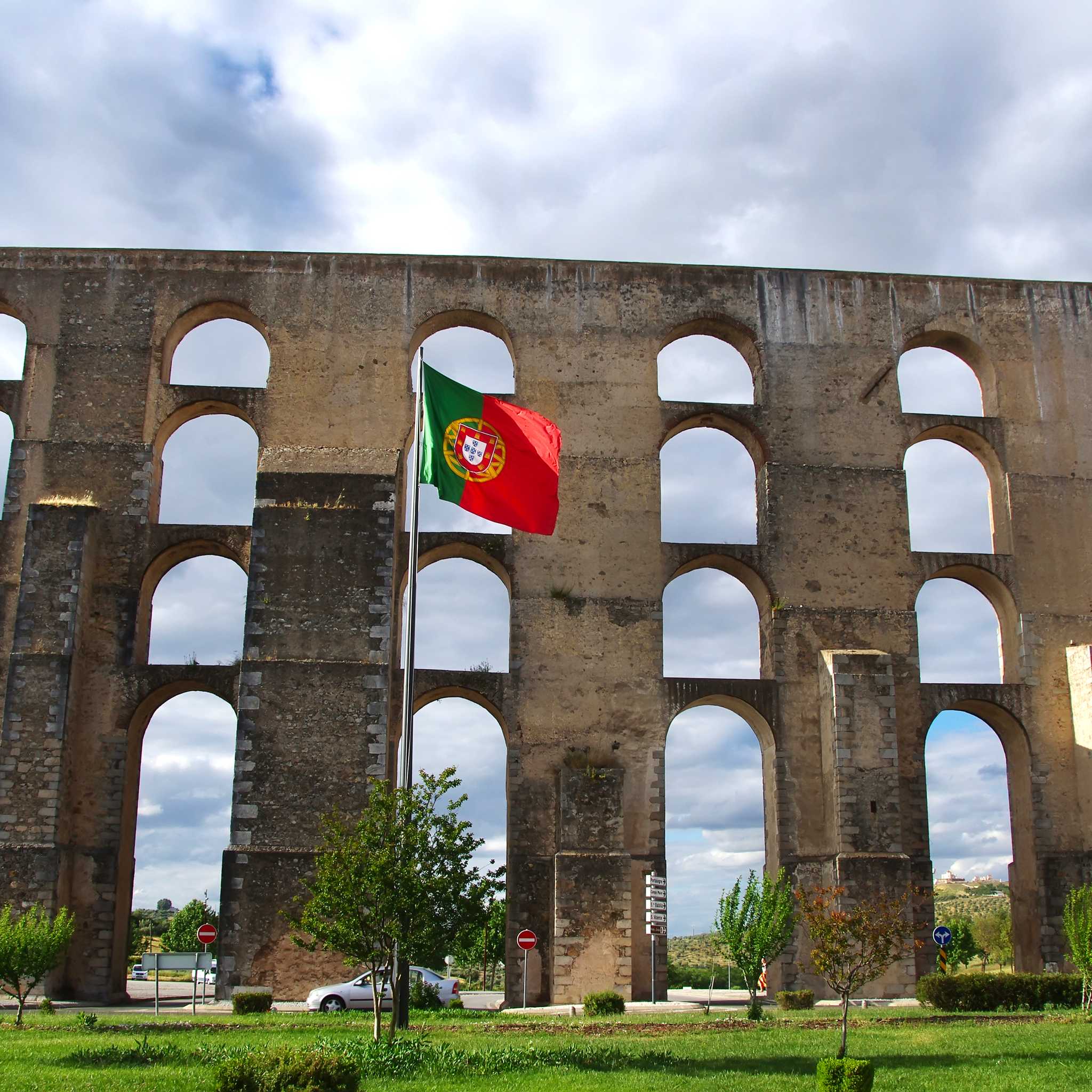
Start at the Amoreira Aqueduct, whose arches lead straight into town. Inside the walls, climb to the Moorish-medieval castle for views over the fortifications, wander the Praça de Santa Clara with its colorful tiled houses, and step into the squat, fortress-like cathedral. The 17th-century star-shaped ramparts and forts ring the whole historic center.
The Amoreira Aqueduct stretches roughly 7 km and carries 843 arches into the heart of Elvas, some rising over 30 meters high. Designed by Francisco de Arruda, the same architect behind Lisbon's Belém Tower, it was built to keep the besieged city supplied with water. It's one of the most striking approaches to any walled town in Europe and worth pausing for before you even pass through the gates.
Built to guard Portugal's border with Spain, Elvas developed into one of the largest bulwarked dry-ditch fortification systems in the world. Its star-shaped defenses withstood Spanish sieges in 1659, 1711, and 1801, only falling to French forces in 1808. That unbroken defensive engineering, layered from Islamic and medieval walls through 19th-century forts, is why UNESCO listed the whole town as a World Heritage Site.